Tools · Market making
Solana Grid Trading Bot: Buy Lower, Sell One Line Higher
A bot with a wallet of its own that buys as the price falls through a ladder of lines and sells one line higher, until you stop it. Devnet only for now.
Open in the app →Read the full guide
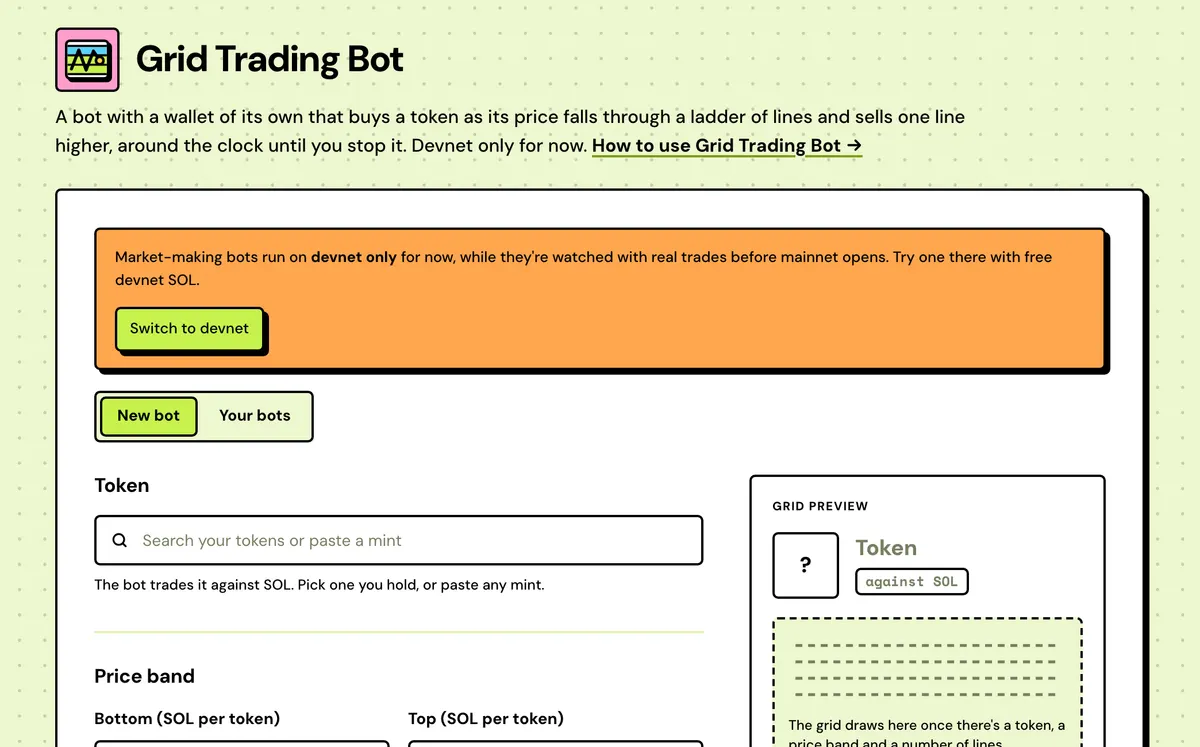
What the Grid Trading Bot does
A wallet of its own
Each bot trades from a wallet made for it, holding only what you fund it with. You sign once; every trade after that is signed by the bot's key.
Geometric lines
From 3 to 60 lines, each the same percentage above the last, so every slot makes the same percentage on a round trip.
Ladder preview
Before you sign, the preview draws the grid: lime slots buy on the way down, blue slots sell on the way up, and yellow marks the price now.
Funding worked out
The form computes the SOL for the buy slots and the tokens for the sell slots at the price now, and checks your wallet holds both.
Fill guards
A fill may land at most half a line-step past its line, and an order that would move the price more than a quarter of the spacing waits.
Live bot page
What it holds, its value against just holding, a chart with a point every 10 minutes, the grid as it stands, and every action with a Solscan link.
Solana Grid Trading Bot: Complete Guide
What is a grid trading bot?
A grid trading bot splits a price range into lines and trades the swings between them. Each time the price falls to a line, it buys a fixed amount of SOL's worth of the token. Each time the price rises one line above that buy, it sells those same tokens. A token that keeps swinging inside the range gets bought low and sold higher, again and again, and each round trip's profit lands in SOL.
Solstack's grid runs on its server around the clock, from a wallet made for that one bot. You fund it with one transaction. From then on no tab needs to stay open, and stopping it sends everything back to the wallet that funded it. It runs on devnet only for now, with free SOL from the faucet, while the bots are watched with real trades before mainnet opens.
How to use the Solana Grid Trading Bot
- Connect your wallet and pick the token to trade against SOL.
- Set the price band, or tap a ±10–50% preset around the price now.
- Choose the number of lines and the SOL each order spends.
- Check the ladder preview and what the bot starts with.
- Sign once to fund the bot's wallet, then follow it on its own page.
Who it's for
Holders of a token that moves up and down within a range, who would rather sell its swings than sit through them. A grid doesn't predict anything: it buys a little each time the price drops a line and sells it again one line higher. It suits a range you expect the price to stay in for a while, and does nothing useful for a token that only goes one way.
How the lines trade
- From 3 to 60 lines, spaced geometrically: each line is the same percentage above the last.
- Every gap between two lines is a slot. A slot holding SOL buys at its lower line; a slot holding tokens sells them at its upper line.
- A slot flips each time it fills, so it always buys one line below where it sells.
- At the start, slots above the price hold tokens and the rest hold SOL.
- Below the band it has bought at every line and holds; above it, it holds only SOL. It picks up again when the price comes back.
Guards against bad fills
- A fill may land at most half a line-step past its line, kept between 0.3% and 3%. A worse quote waits for the next check.
- An order that would move the price more than a quarter of the line spacing waits, so in a thin pool the bot can't set off its own next line.
- The price is checked about every 15 seconds. In a fast move the bot fills at most 4 lines per check and catches up on the next.
- Lines under 1.5% apart get a warning before you sign. Under 0.5% is refused, since fees would eat the gap.
Your keys and the bot's wallet
Your wallet's keys stay in your wallet. The bot trades from a separate wallet of its own, holding only what you put in it, and stopping it sends everything back to you. Solstack's server makes that wallet's key, keeps it sealed and uses it only for that bot. Pause, Resume and Stop ask your wallet to sign a message, not a transaction, and only the wallet that funded the bot can use them.
Risks and limits
A grid can lose money. If the price falls out of the band, the bot is left holding tokens it bought on the way down. If the price rises out of it, the bot holds only SOL and stops earning. Lines set close together leave little after swap fees. On mainnet, orders go through Jupiter for the best route; on devnet, through a Meteora DLMM pool you pick. Check the token first with the Solana Token Inspector. Not financial advice.
An example grid
A token at 0.001 SOL, a band from 0.0008 to 0.0012 (±20%), 6 lines and 0.1 SOL orders. The lines land 8.45% apart, which makes 5 slots. The price sits in the third, so the bottom three start with SOL and the top two with tokens, counted as bought at their lower line.
So the bot starts with 0.3 SOL and about 188 tokens (190 with the 1% headroom the form adds). Each round trip makes about 0.0076 SOL after an estimated 0.4% swap cost each way.
| Slot | Lines (SOL per token) | Starts with |
|---|---|---|
| 5 | 0.001107 to 0.0012 | 90.37 tokens, sold at 0.0012 |
| 4 | 0.00102 to 0.001107 | 98.01 tokens, sold at 0.001107 |
| 3 | 0.0009409 to 0.00102 | 0.1 SOL, buys at 0.0009409 |
| 2 | 0.0008676 to 0.0009409 | 0.1 SOL, buys at 0.0008676 |
| 1 | 0.0008 to 0.0008676 | 0.1 SOL, buys at 0.0008 |
Who can do what
| Action | Who | How |
|---|---|---|
| Trade at a line | The bot | On its own, when the price crosses one of its lines |
| Pause and resume | The wallet that funded it | A signed message, not a transaction. Paused, it makes no trades |
| Stop and withdraw | The wallet that funded it | Every token and every lamport comes back. It can't be restarted |
| Change the band, lines or order size | Nobody | Stop it and start a new bot |
| Watch it | Anyone with the link | The bot's page needs no wallet |
What it costs
0.1 SOL flat per bot, paid once in the funding transaction. Trading, pausing and stopping are free. Each swap pays the pool's fee (and Jupiter's on mainnet), and 0.02 SOL stays in the bot's wallet for network fees; what's left comes back when it stops.
FAQ
Is it free to run?
Starting a bot costs 0.1 SOL, once. After that Solstack charges nothing for trading, pausing or stopping. Swaps pay the pool's own fee, and on mainnet Jupiter's.
How much does each round trip make?
The gap between two lines, less swap fees. With lines 5% apart and 0.1 SOL orders, a buy then a sell turns 0.1 SOL into about 0.105 SOL before fees. The preview shows the figure after an estimated 0.4% swap cost each way.
What does it start with?
SOL for every slot below the price and tokens for every slot above it, both worked out by the form at the price now. Your wallet has to hold the tokens.
Does it trade when the price is flat?
No. It trades only when other people's trades move the price across one of its lines.
Can I change the band later?
No. Stop the bot, which sends everything back, and start a new one with the new band.
Which tokens can it trade?
Any token priced against SOL. One with a live freeze authority needs an extra tick. Token-2022 tokens with a transfer hook, non-transferable ones and ones whose new accounts start frozen are refused.
How big can a bot be?
It can start with up to 100 SOL.
Is it on mainnet?
Not yet. It runs on devnet only for now, until the bots have been watched with real trades.