Tools · Analyze
Solana Token Inspector: A 0–100 Safety Score for Any Mint
Authorities, LP lock, wallet forensics, liquidity and momentum for any mint, rolled into one safety score.
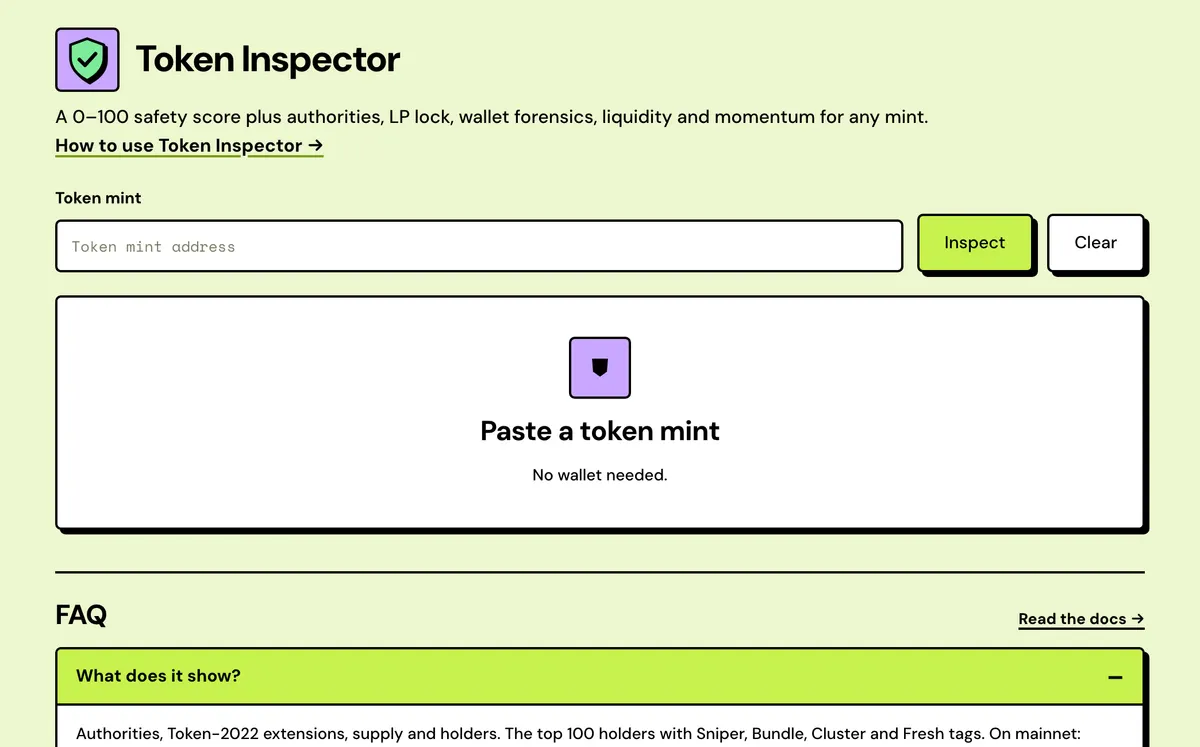
How to use the Solana Token Inspector
- Paste a mint address.
- Wait for the fast checks — authorities, extensions, holders.
- Slower checks land after: LP lock, wallet forensics, trend, deployer history.
- Read the score breakdown and holder tags.
- Authorities and extensions
- Who holds the LP
- Wallet forensics
- Supply concentration
- Lookalikes and listing
- Deployer track record
Watch it done
FAQ
Does a high score mean safe?
No — it means the on-chain rug mechanisms are absent. It can't read intent or simulate a trade.
What are the holder tags?
Sniper: bought within 5 minutes of launch. Bundle: shared first-buy fee payer. Cluster: shared SOL funder. Fresh: under a week old.
Does it need a wallet?
No.
Why did the score change after loading?
The slower checks land after the first score appears, and each one can add deductions.
Can I share the result?
Yes. Share turns the score into a one-page report image you can post to X or download as a PNG.
Is it free?
Yes. No wallet, no sign-up, nothing to sign.
Everything about the Solana Token InspectorFeatures in full, how it compares, costs and the complete guide
What we check
Authorities and extensions
Mint, freeze and metadata authorities, plus Token-2022 permanent delegate, transfer hook, non-transferable flag, close authority and whoever can change the transfer fee.
Who holds the LP
The deepest pool's LP tokens: burned, locked in Streamflow, Jupiter Lock, Raydium Burn & Earn or Solstack's locker, or in a wallet that can pull them.
Wallet forensics
The top 100 holders tagged as snipers, bundles, funding clusters or fresh wallets. Exchanges and trading terminals that fund thousands of wallets don't count as clusters.
Supply concentration
What the 10 largest non-pool wallets hold together, every single wallet above 4% of supply, the deployer's own share, and the total holder count.
Lookalikes and listing
Whether a Jupiter-verified token already uses this name or ticker under another mint, whether Jupiter indexes the mint, and Jupiter's organic score.
Deployer track record
The creator's other tokens: how many have no liquidity left, and whether any still trade at $250K+ market cap a week after launch.
Solstack vs other Solana rug checkers
One 0–100 score with every deduction shown, and a look at who is behind the top wallets.
Solstack Token Inspector
- Lists every finding with the points it cost, across nine areas
- Groups the top 100 holders by shared SOL funder and shared first-buy fee payer
- Flags a name or ticker that a Jupiter-verified token already uses under another mint
- Halves authority penalties for Jupiter-verified tokens with $1M+ liquidity
- Free in full: no wallet, no sign-up, and a shareable one-page report image
Typical rug checker
- Often a single score or a Good, Caution or Danger label with a short list of flags
- Many report top-10 concentration only; some flag bundles or insiders
- Usually not checked; mutable metadata is the closest signal
- Usually rate a live mint authority as high risk whatever the token
- Mostly free to scan; some keep full access for paid plans, $50 a month at one
Solana Token Inspector: Complete Guide
What the Token Inspector checks
Paste a mint and Token Inspector checks the things that actually cause rugs and scams: live mint or freeze authority, transfer hooks and taxes, where the LP sits (burned, locked, or in a wallet that could pull it), and the top 100 holders tagged for sniping, bundling, clustering and freshness. On mainnet it adds price, liquidity depth, lookalike detection and deployer history.
Everything feeds one score out of 100, starting at 100 with a fixed deduction per finding — a high score means the on-chain rug mechanisms are absent, not that the token is a good investment.
When to use it
Before you buy a token, before you list one, or when a token you don't recognise lands in your wallet. Paste the mint: no wallet, nothing to sign. Authorities, extensions and holders land first; wallet forensics, the LP lock, lookalikes, deployer history and trends fill in after, with a strip showing what's still pending.
How the score works
- Every token starts at 100, and each finding takes off a fixed number of points. Anything that lets someone take your tokens costs far more than signals that only correlate with scams.
- Critical, capping the score at 20: a permanent delegate, a mint whose tokens can't be transferred, or a freeze authority that's already being used.
- Serious: a live freeze authority (45 points), a live mint authority or a transfer hook (30), and LP tokens held in ordinary wallets (15 to 25, by share).
- Smaller: a fee authority that can still change the transfer tax costs 10, while a fixed tax costs nothing. Copying a verified token's ticker costs 3, or 10 with its name too.
- After those come holder patterns, such as clustered, bundled or sniping wallets and heavy concentration, and the deployer's track record. Momentum, liquidity depth and the token's age weigh least.
- A token that Jupiter has verified and that has at least $1M of liquidity loses only half the usual points for live authorities.
What a high score doesn't tell you
The score measures whether the on-chain mechanisms behind most rugs are present. It can't read the team's intent or simulate a trade, and a token can pass every check while its chart is being manipulated. Treat it as one input. Price, liquidity, volume and market cap come from Jupiter and DexScreener, trends from GeckoTerminal and Birdeye, and all market data is mainnet only.
How to read the safety score
Any high-severity finding holds the score at 79 or below, and any critical one at 20 or below. Credits for deep liquidity, Jupiter verification, smart-money holders or a deployer's lasting launches only win back points lost to low and medium findings.
| Score | Verdict | What it means | What to do |
|---|---|---|---|
| 80–100 | Low risk | No high or critical finding. Low or medium flags only, if any. | Still check the chart and liquidity. The score can't read intent. |
| 55–79 | Moderate risk | At least one serious finding, or several medium ones. | Open each deduction and see whether it applies to you. |
| 30–54 | High risk | Serious findings stack up: live authorities, LP in a wallet, linked top holders. | Treat it as a rug setup unless each finding has a known reason. |
| 0–29 | Critical | A critical finding, such as a permanent delegate or frozen accounts, or many serious ones. | Avoid buying. Check whether you can still sell what you hold. |
Solana token safety checklist
Each line below is a point where the Token Inspector stops deducting. A token can pass all of them and still fall in price, so size any buy accordingly.
- Mint authority revoked, so the supply is fixed.
- Freeze authority revoked, and no holder accounts frozen.
- On Token-2022: no permanent delegate, no transfer hook, and no authority left that can change the transfer fee.
- The main pool's LP tokens burned or locked, not held by a wallet. For a Solstack lock, the LP Lock Verifier shows the unlock date.
- The 10 largest non-pool wallets hold under 20% between them, and no single wallet holds more than 4%.
- No two top holders funded by the same wallet, and no shared first-buy fee payer, or those groups have sold down.
- At least 500 holders, and the count not down 8% or more over the past week.
- A name and ticker that don't copy a Jupiter-verified token.
- At least $50,000 of liquidity, worth at least 2% of the market cap.
- A deployer whose earlier tokens still have liquidity.
What it costs
Free.
Guides
- A Beginner's Guide to Solana Token Security15 min read