Tools · Analyze
Smart Money Tracker: Are a Token's Top Holders Winning?
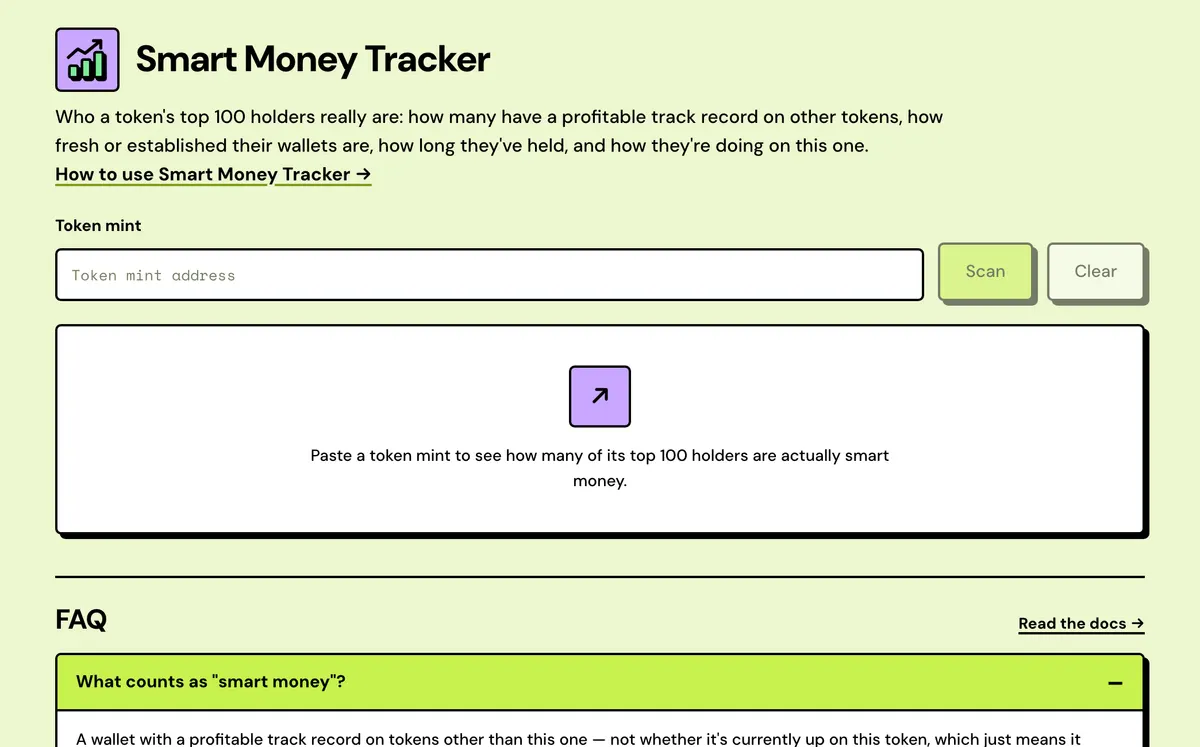
See how many of a token's top 100 holders have a profitable record on other tokens, and how long they've held this one.
How to use the Smart Money Tracker
- Paste a token mint.
- Wait for holder balances and first-buy forensics to load.
- Review win rate and PnL pulled per wallet.
- Cross-check against Token Inspector's holder tags.
- Top 100 by balance
- Track record elsewhere
- Wallet age
- Holding time
- PnL on this token
- CSV and share card
FAQ
What counts as "profitable"?
Realized plus unrealized PnL on this token is positive — it says nothing about their track record on other tokens.
Where does PnL come from?
Birdeye's per-wallet PnL data, all-time for this mint. Mainnet only.
Does it need a wallet?
No.
Is the smart-money verdict based on PnL on this token?
No. It uses each wallet's record on other tokens. PnL on this token is shown separately, mainnet only.
Why does a wallet say "No buys"?
It received the token without buying it, so there's no cost to measure a profit against.
Everything about the Smart Money TrackerFeatures in full, how it compares, costs and the complete guide
What the Smart Money Tracker reads
Top 100 by balance
Every token account is read and the 100 largest holders picked. Large tokens get 45 seconds to page through before the scan stops.
Track record elsewhere
Each holder's 10 most recent transactions, minus anything touching this mint, netted for SOL in and out. A positive total reads as profitable elsewhere.
Wallet age
Wallets under a week old never count as smart money. Wallets over a year old are tagged Established and lift the headline share.
Holding time
When each wallet first bought, with the group's average and median time held, and on mainnet how many have never sold.
PnL on this token
On mainnet, Birdeye's per-wallet figures: invested, value now, realized and unrealized profit, plus the group's totals, average and median.
CSV and share card
Export all 100 rows with 14 columns, including first-buy time and the fresh, established and smart-money flags, or post the card to X.
Solstack vs other Solana smart money trackers
Starts from one token's holders and judges each wallet on what it did elsewhere.
Solstack Smart Money Tracker
- Starts from a token and reads its current top 100 holders
- Judges each wallet on its activity away from this token
- Wallet age changes the result: fresh wallets never count, year-old ones add weight
- Shows how long each holder has held this token
- Free, with no wallet or sign-up; all 100 rows export as CSV
Typical smart money tracker
- Usually starts from a leaderboard of top traders or wallets you choose to follow
- Often ranks wallets by overall PnL or win rate over a recent window
- Wallet age is rarely part of the label
- Leaderboards usually show trader PnL, not time held in one token
- Several pair the data with sign-up, paid API plans or copy trading
Smart Money Tracker: Complete Guide
What the Smart Money Tracker asks
Smart Money Tracker looks at the same top 100 holders Token Inspector already tags for sniping and bundling, but asks a different question: are they making money? Each wallet's realized plus unrealized profit and loss on the token comes from Birdeye's per-wallet trade history, mainnet only.
Holding time comes from each wallet's first buy, so a high win rate combined with long average hold times reads very differently from a high win rate driven by wallets that bought minutes ago.
What counts as smart money
Here, smart money means a wallet that has made money on other tokens. A wallet that's simply in profit on this one doesn't qualify, since that may only mean it bought early. For each top holder that isn't fresh, a sample of its recent transactions is read, anything touching this mint is dropped, and the SOL that flowed in and out across the rest is netted. A positive total reads as a profitable trader. It's a blunt measure (a large incoming transfer looks like a winning trade), but it judges how a wallet trades elsewhere, not how lucky it got here.
How the headline number is built
- The share of analysed wallets with a profitable record elsewhere.
- Minus up to 10 points when the list leans fresh. Wallets under a week old never count as smart money, because there's no record to check yet.
- Plus up to 10 points when many holders are established wallets over a year old.
Reading the table
- Holds: share of supply, with the balance.
- Held for: how long since the wallet first bought. Everyone in the table still holds, so it's a true holding period.
- Track record: a label, either Fresh wallet, Profitable elsewhere, Established or No signal.
- Invested, Value now and PnL (mainnet): from Birdeye's per-wallet data for this mint. No buys means the wallet received the token without buying it.
- Export CSV downloads all 100 rows; Share posts the card to X as an image.
Limits
- Only current top-100 holders are shown, so wallets that already sold out are missing.
- Profit and loss figures need mainnet. Devnet still shows the holders, how long they've held and their track records.
- Tokens with tens of thousands of holders are slow to page through, and the scan stops after 45 seconds. Your own RPC, set on Solana Network Status, helps.
- Pair it with the Solana Token Inspector, which tags the same holders for sniping, bundling and clustering.
What it costs
Free.