Tools · Utilities
Solana Vanity Address Generator
A keypair whose address starts or ends with your text, ground entirely in your browser.
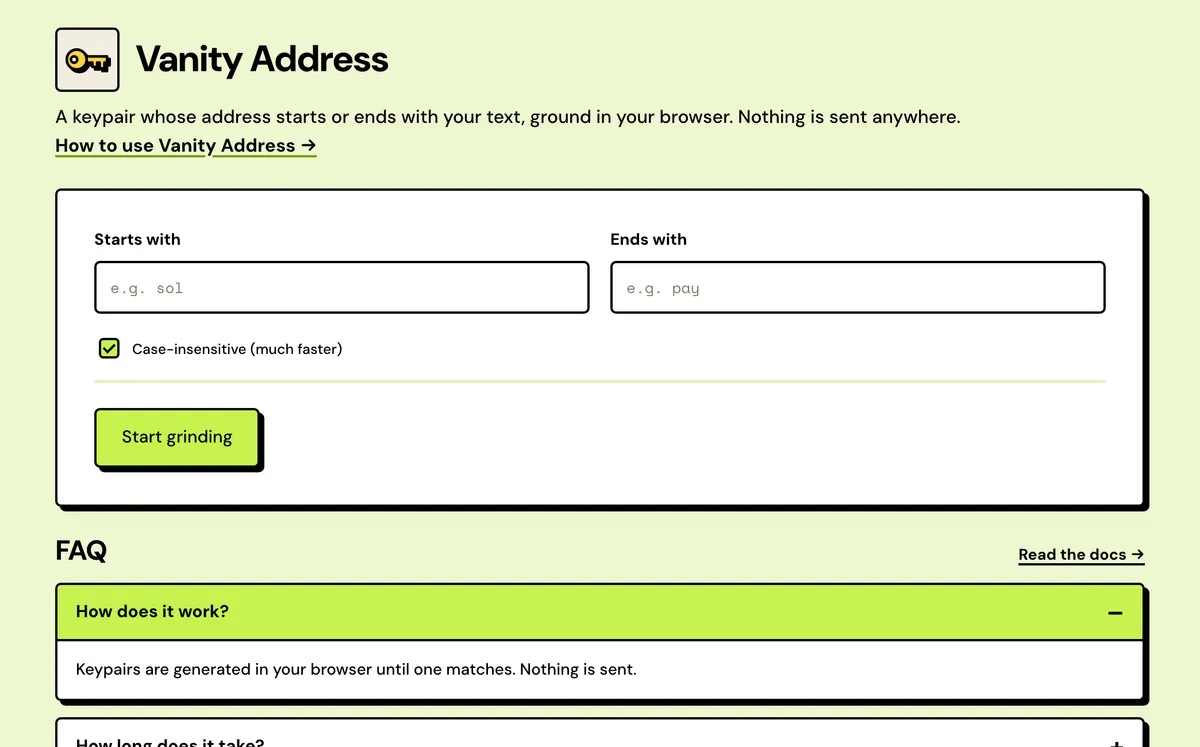
How to use the Vanity Address Generator
- Enter the prefix and/or suffix you want.
- Start grinding. Keys tried, keys per second and the odds of a match show live.
- Copy the keypair (base58 or byte-array file) once found.
- Prefix, suffix or both
- Either case by default
- Base58 check
- Live counters
- Two key formats
- Stop any time
FAQ
How does it work?
Keypairs are generated in your browser until one matches. Nothing is sent.
How long does it take?
Each character is 30–58x rarer; four characters takes a while, five or more is impractical.
Can I import it into Phantom?
Yes, with the base58 key or the byte-array file.
Is a vanity address less secure?
No. It's as random as any wallet key. What matters is how you store the secret key.
What's the longest pattern I can use?
Six characters in total, prefix and suffix combined.
Is anything sent to Solstack?
No. Keys are generated and checked in your browser and never leave it.
Everything about the Solana Vanity Address GeneratorFeatures in full, costs and the complete guide
What the generator does
Prefix, suffix or both
Match the start of the address, the end, or both at once, up to six characters in total.
Either case by default
With case-insensitive on, each letter can match two ways, so it's about twice as likely to turn up. Untick it when the exact case matters.
Base58 check
The pattern is checked before the search starts. 0, O, I and l never appear in Solana addresses, so they're refused.
Live counters
Keys tried and keys per second update after every batch of 3,000, alongside the rough odds of any one key matching.
Two key formats
The secret key comes as a byte array for the Solana CLI, downloadable as a JSON keyfile, and as base58 for importing into a wallet.
Stop any time
Stop ends the search straight away. Nothing is stored, so starting again begins a fresh, independent search.
Solana Vanity Address Generator: Complete Guide
How a vanity address is found
Vanity addresses are generated by brute force — your browser keeps producing random keypairs until one matches the prefix or suffix you asked for. Nothing is sent anywhere; the whole search happens locally.
Short strings (three or four characters) take seconds to minutes; each extra character multiplies the search by roughly 30–58x, so five or more characters can take a very long time.
What a vanity address is
A normal Solana keypair, except that its address begins or ends with text you chose: a brand, your initials, a short word. It's exactly as random as any other key; finding it just meant generating a great many. People use them for a project treasury, a personal wallet, or anywhere an address that's easy to recognise is useful. If it's a token's mint address you want, the SPL Token Creator and Token-2022 Creator grind one for you under Advanced.
Choosing a pattern
- Starts with, ends with, or both at once.
- Base58 characters only, which rules out 0, O, I and l.
- Case-insensitive is on by default and much faster, because each letter can match two ways.
- Six characters in total is the cap, prefix and suffix combined.
- Keep the tab in front while it runs.
Saving the key
When a match turns up you get the address and its secret key in two forms: a byte array, the standard keyfile the Solana CLI reads, which you can download as JSON, and base58, which wallets such as Phantom import. Copy or download it before leaving the page: it isn't saved or sent anywhere, so once the tab closes it's gone for good. Anyone with the secret key controls the address, so keep it out of websites and screenshots.
How long it takes
Each extra character makes a match roughly 30 to 58 times rarer, depending on whether case matters. Three characters usually takes seconds; every character after that multiplies the wait, so five or more can run for hours in a browser. Before you start, the page shows the odds of a match, then counts keys tried and keys per second as it runs. Letters late in the alphabet are rarer at the start of an address than 1–9 or A–J, while the same letters as a suffix come faster.
How long a pattern takes
Average keys tried for a pattern of letters, and the time at 8,000 keys per second, about what one laptop core manages in a browser tab. Your real rate shows while it runs. Half of all searches finish in under 70% of the average. Digits, and the letters i, o and L, have only one form in base58, so they count as exact case either way.
| Characters | Exact case | Ignoring case |
|---|---|---|
| 1 | 58 · instant | 29 · instant |
| 2 | 3,364 · under 1 s | 841 · instant |
| 3 | 195,112 · about 24 s | 24,389 · about 3 s |
| 4 | 11.3 million · about 24 min | 707,281 · about 1.5 min |
| 5 | 656 million · about 23 h | 20.5 million · about 43 min |
| 6 | 38 billion · about 55 days | 595 million · about 21 h |
Why the first letter matters
An address is a 32-byte key written in base58, so about 94% of addresses are 44 characters long and only a few characters can lead them. For the first character of a prefix, the odds are far from 1 in 58.
- So
XYZas a prefix needs about 3.4 million tries on average, whileXYZas a suffix needs about 195,000. - If your word starts with a late letter, try it as a suffix instead.
- With case-insensitive on, a prefix starting with a–h can also match A–H, which makes it quick again.
| First character | Share of addresses | Compared with 1 in 58 |
|---|---|---|
| 2–9, A–H | About 1 in 17 | 3.4 times easier |
| J | About 1 in 70 | Slightly harder |
| K–Z, a–z | About 1 in 1,000 | 17 times harder |
| 1 | About 1 in 256 | 4.4 times harder |
What it costs
Free — pure browser compute.