Tools · Distribute
Solana Token Airdrop: Reward Every Holder of a Token
Send a token to every current holder of another token — a flat amount each, or split pro-rata by what they hold.
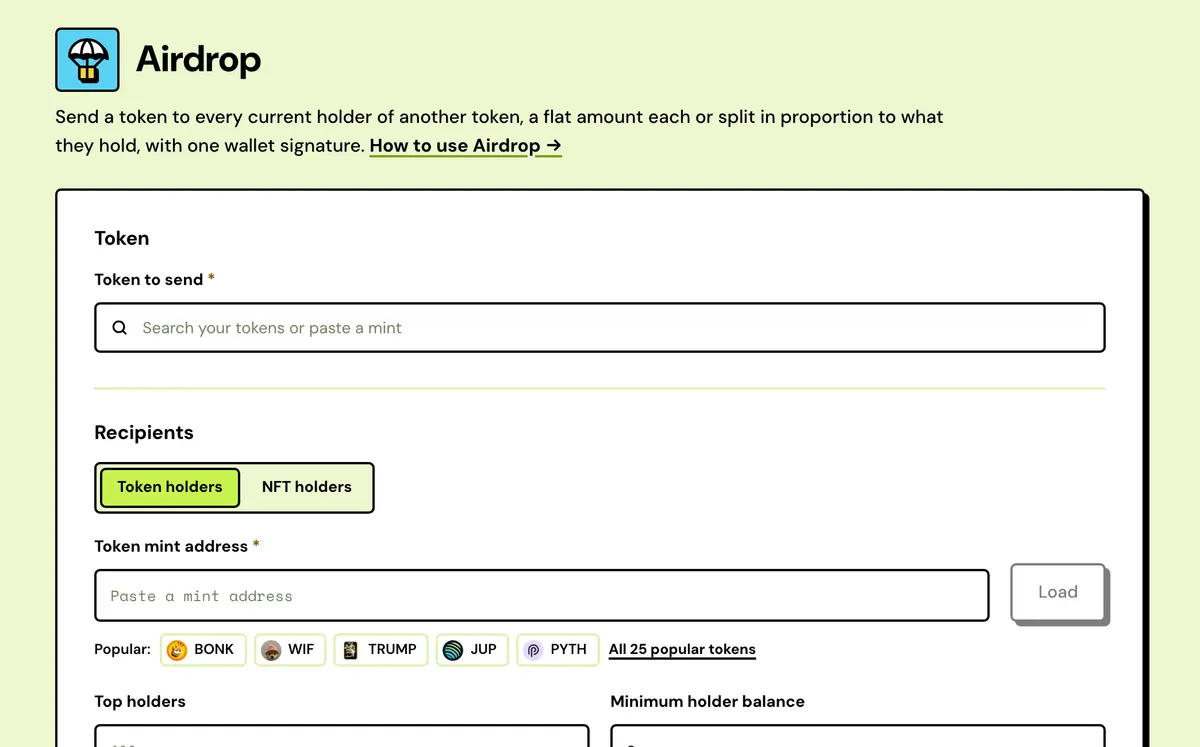
How to use the Solana Airdrop tool
- Connect your wallet.
- Pick the token to send, then who receives it: a token's or NFT collection's holders, a token's recent traders, or a wallet group (KOL wallets, JUP stakers, a DAO's members).
- Set the filters you want (SOL balance, recent activity, must also hold), then preview the list.
- Choose flat or pro-rata, then approve once — Solstack's server sends every batch.
- Token or NFT holders
- Traders, KOLs, stakers, DAOs
- Program and exchange wallets removed
- Filters for real wallets
- Free list export
- Frozen holders skipped
Watch it done
FAQ
Who receives tokens?
Current holders of the token or NFT collection you pick, or on Mainnet a token's recent traders, KOL wallets, JUP stakers or a DAO's members, flat or pro-rata. Pools, other program-owned addresses, burn addresses and exchange wallets are left out, and so is your own wallet.
Is the snapshot live?
It's taken the moment you preview, and that's the list you sign.
Is there a recipient limit?
No. Every eligible holder is included, 9 per transaction, still with one signature — raise the minimum balance to trim dust holders for a smaller run.
Is this where I claim a Solana airdrop?
No. This tool is for the project doing the sending: you pick a token you hold, and it goes out to every holder of another token. To claim an airdrop you were promised, use that project's own claim page — Solstack doesn't run claims and never asks for a seed phrase.
Can I airdrop to NFT holders?
Yes. Pick an NFT collection instead of a token, and every wallet holding at least the minimum number of its NFTs is included. Pro-rata gives a wallet with three NFTs three times the share of one with a single NFT.
Which tokens can I send?
Any SPL or Token-2022 token in your wallet. Holders can be read from a token of either standard, or from an NFT collection.
Can I airdrop to KOL wallets?
Yes. Recipients → Wallet groups → KOL wallets sends to 104 traders and influencers whose wallets are publicly labelled, from the public Dune query "Solana KOL Wallets". Each wallet was checked on-chain: it holds SOL and made a transaction in the 90 days before the check. Every wallet gets the same share.
Can I airdrop to active wallets only?
Yes. Under Filters, a minimum SOL balance skips empty and dust wallets, and "Had a transaction in the last … days" keeps only wallets with recent activity. The activity check reads wallets one at a time, about 3½ minutes per 1,000, and counts tokens sent to a wallet as activity too, so use it with a SOL minimum.
Everything about the Solana Token AirdropFeatures in full, costs and the complete guide
What the Airdrop tool does
Token or NFT holders
Reward the holders of any SPL or Token-2022 token, or of an NFT collection, where each wallet is weighted by the NFTs it holds.
Traders, KOLs, stakers, DAOs
On Mainnet, send to a token's recent buyers, 104 KOL wallets, JUP stakers or a Realms DAO's members instead of a holder list.
Program and exchange wallets removed
Pools, bonding curves, vaults, multisigs, burn addresses, exchange hot wallets and your own wallet are left out.
Filters for real wallets
Keep wallets with a minimum SOL balance, a recent transaction, or a second token or collection they also hold, on top of Top and a minimum balance.
Free list export
Export the previewed recipients and amounts as a CSV at no charge, to keep a record or edit and send through the Multisender.
Frozen holders skipped
Holders whose account for the token you send is frozen are left out of the quote, and every other holder is still paid.
Solana Token Airdrop: Complete Guide
What is a holder airdrop?
Airdrop is for rewarding a community you don't have a list for. Pick the token you're sending from your wallet (or paste its mint). Then choose whose holders get it: a token's or an NFT collection's. On Mainnet, popular tokens and collections are one click; anything else, paste its address and press Load to check its name, logo and supply. They can be the same token. Solstack reads the holders at the moment you preview, sums balances per wallet, leaves out pools, other program-owned addresses and burn addresses, and builds the recipient list on the spot.
On Mainnet there are more lists to send to: a token's recent traders (its buyers, or buyers and sellers, over up to 30 days), KOL wallets (104 traders and influencers with public wallets), JUP stakers, or the members of a Realms DAO. Filters then keep the list to wallets a person uses: exchange hot wallets are left out by default, and you can ask for a minimum SOL balance, a transaction in the last so many days, or a second token or collection the wallet must also hold.
Split flat (the same amount to everyone) or pro-rata (a pool divided by each wallet's share of what's held, or of the NFTs held). Top holders keeps just the largest wallets. Already have a list of addresses and amounts? Multisender is the more direct route.
What a 1,000-holder airdrop costs
A drop to 1,000 holders who have never held your token costs 1 SOL in Solstack fees (0.001 SOL per recipient; past 1,000 the rate drops) and about 2 SOL in token-account rent, across 112 batches of 9 recipients, all from one wallet signature. The cost panel shows the count and total before anything is signed. Raising the minimum balance trims dust wallets, and the cost with them.
Who else you can send to
- Recent traders: wallets that bought a token, or bought and sold it, in the last 1 to 30 days, weighted by the USD they traded. The latest 10,000 trades are read, so for a busy token the window is hours.
- KOL wallets: 104 traders and influencers with public wallets, each checked on-chain for SOL and a transaction in the last 90 days.
- JUP stakers: every wallet staking JUP in Jupiter's DAO, largest stake first, read from the staking program itself.
- DAO members: every member of a Realms DAO, weighted by the tokens deposited. Pick Bonk DAO and others in one click, or paste any realm address.
Filters
- Leave out exchange wallets (on by default): Binance, Coinbase, OKX, Bybit, Kraken and other exchange hot wallets, where tokens reach no one.
- Minimum SOL balance: skips empty and dust wallets. Checked 100 wallets at a time.
- Had a transaction in the last … days: keeps wallets with recent activity. It's read one wallet at a time, about 3½ minutes per 1,000, and tokens sent to a wallet count too.
- Must also hold: keeps only wallets that also hold a second token, or an NFT from a collection.
- The filters run from the top of the list down and stop once Top is filled, so the slow checks never run on wallets that would be cut anyway.
Flat or pro-rata
- Flat: every eligible wallet gets the same amount, so the total is the amount times the number of recipients.
- Pro-rata: you set a pool, and each wallet gets its share of the combined balance of all eligible wallets. Amounts are rounded down to the sent token's decimals, so the total lands at or just under the pool.
Is it safe?
Your wallet's keys never leave your wallet. You sign one transaction: it approves a key made for this airdrop to spend exactly the preview's total — the tokens stay in your wallet until each batch sends them — and gives it SOL for rent and fees. Solstack's server holds that key and sends each batch (an idempotent create for the recipient's token account and one checked transfer for the exact amount in the preview), then returns the SOL it didn't use. Close the tab and it keeps going; cancel from the job page any time, and whatever is left of the approval is revoked for you. Your own wallet is left out of the list automatically.
The snapshot is a moment in time. Someone who buys after the preview isn't included, and someone who sold since still is, so preview again right before sending if the gap matters.
Who counts as a holder
Solstack reads every token account of the mint and sums them per wallet, so a wallet with three accounts is one recipient with its balances combined. Liquidity pools, other program-owned addresses and burn addresses are left out, and so is your own wallet. A minimum balance drops dust wallets; Top holders keeps only the largest. For an NFT collection, a wallet counts once, with the number of its NFTs as its weight.
Flat and pro-rata, with numbers
- Flat, 10 tokens each, 1,000 holders: 10,000 tokens leave your wallet and every holder gets the same.
- Pro-rata, a 10,000-token pool, three holders with 50, 30 and 20 of the snapshot token: they get 5,000, 3,000 and 2,000.
- Amounts are rounded down to the sent token's decimals, so the total lands at or just under the pool.
Before you send
- Preview again right before signing if the market is moving: the list you sign is the preview's.
- Rehearse on devnet with a test token. Same flow, and the Solana Devnet Faucet pays for it.
- Budget the rent: about 0.0015 SOL for each recipient who has never held the token, on top of the fee.
- Keep the tab open or not. The send runs on Solstack's server, and Distribute → Manage shows every batch and signature.
Airdrop or Multisender?
Airdrop builds the list from the chain. If you already have addresses and amounts, the Solana Multisender sends them with a single signature. To get the holder list without sending anything, use the Solana Token Holder Snapshot.
Who is left out of an airdrop
| Address | Why it's left out |
|---|---|
| Liquidity pools and bonding curves | Owned by a program, not a person. Tokens sent to a pool's own account are lost to it. |
| Vaults and multisigs | Off-curve addresses with no single owner to receive a reward. |
| Burn and incinerator addresses | Nobody can sign for them, so anything sent there is gone. |
| Exchange hot wallets | Binance, Coinbase, OKX, Bybit, Kraken and others hold tokens for customers, so a reward sent there reaches no one. Left out unless you turn the filter off. |
| Your connected wallet | Removed automatically, so you never airdrop to yourself. |
| Wallets under your minimum | Your filter. Raising it trims dust holders and the rent their new accounts would need. |
| Wallets your filters drop | Under the SOL minimum, no transaction in the days you set, or not holding the Must also hold token or collection. The preview counts each. |
| Amounts that round to zero | A pro-rata share smaller than the sent token's smallest unit is dropped. |
Where the holder list comes from
| You pick | How holders are read |
|---|---|
| A popular token (Mainnet) | A ranking of its largest holders, up to the top 10,000, since a full scan of a million-holder token can't finish in a browser. |
| Any other token | Every token account of the mint, summed per wallet. A very large token can hit the scan limit, and the preview says so. |
| An NFT collection | Every wallet holding the collection's NFTs, counted once, with the number held as its weight. |
| Recent traders (Mainnet) | Wallets that bought, or bought and sold, the token in the last 1 to 30 days, from Birdeye's trade feed: the latest 10,000 trades, weighted by USD traded. |
| KOL wallets (Mainnet) | 104 publicly labelled KOL wallets from the public Dune query Solana KOL Wallets, each checked on-chain for SOL and a transaction in the last 90 days. Equal shares. |
| JUP stakers (Mainnet) | Every JUP staking account in Jupiter's locked-voter program, about 360,000, ranked by stake. |
| DAO members (Mainnet) | Every membership record in a Realms DAO, weighted by community tokens deposited. |
What it costs
0.001 SOL per recipient for the first 1,000, 0.0008 up to 5,000, 0.0006 up to 25,000 and 0.00035 after, plus ~0.0015 SOL rent for any recipient without a token account yet (0.0016 is set aside and the rest comes back).