Beginner· Lesson 2 of 6· 3 min
SOL, lamports and what a transaction costs
Three different numbers hide behind every fee prompt: a fixed fee, an optional tip and a refundable deposit. Tell them apart and no wallet popup will surprise you again.
Everything on Solana is priced in lamports, and 1 SOL is 1,000,000,000 of them. Wallets show SOL; explorers, programs and error messages talk in lamports. The conversion is the only arithmetic this lesson needs.
1. The base fee
Every transaction pays 5,000 lamports per signature — 0.000005 SOL for the usual single signer. It does not vary with congestion, size or what the transaction does. Half is burned and half goes to the validator that produced the block. At today's prices a thousand transactions cost less than a dollar in base fees.
2. The priority fee
When more transactions want a block than fit, validators order them by an optional tip. You set a price per compute unit in micro-lamports; the tip is that price times the compute-unit limit the transaction asked for. Most of the time it is a few hundred to a few thousand lamports. During a hyped mint or a market move it can climb to millions. All of it goes to the validator. Compute budget and priority fees covers how to set it well.
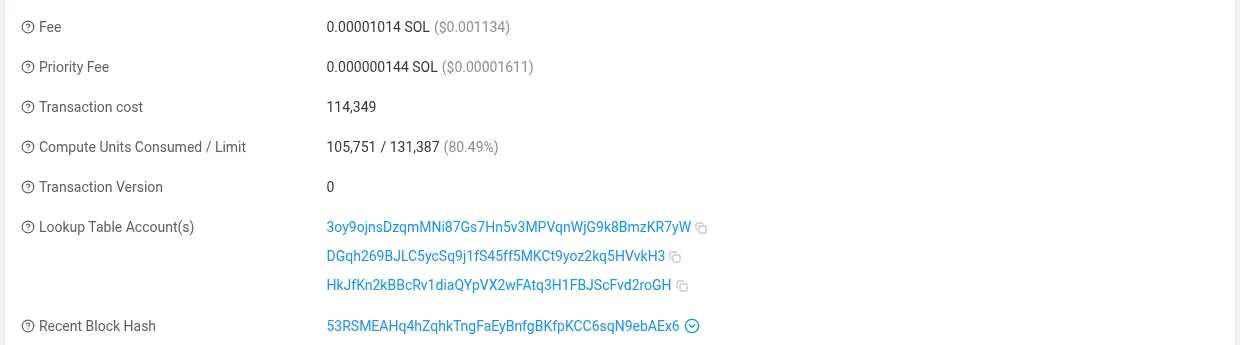
- Total fee: 0.00001014 SOL. Two signatures, so two base fees, plus the tip.
- The tip on its own: 144 lamports. About a hundredth of a cent.
- Compute used against the limit requested. The tip was charged on the limit.
3. Rent deposits
The number that actually moves your balance is usually not a fee at all. Any account a transaction creates — a token account for a coin you have never held, a new mint, a metadata record — must hold a SOL deposit proportional to its size, so validators are paid for storing it. The deposit stays in the account and comes back in full when the account is closed.
| Base fee | 5,000 lamports per signature. Spent. |
|---|---|
| Priority fee | Price per compute unit × limit. Spent. Optional, zero when the network is quiet. |
| Rent deposit | About 0.0015 SOL per token account, 0.0011 per mint, 0.0041 per metadata record. Parked, refundable. |
A worked example
Send a token to a friend who has never held it. The transaction creates their token account, then transfers. Your wallet shows a little over 0.0015 SOL leaving. Of that, 5,000 lamports is the fee; the rest is their account's deposit, which they can reclaim by closing the account once it is empty. Nobody was overcharged — the money simply changed hands as a deposit.
Fees you did not have to pay
Some sites append a transfer to their own wallet inside the transaction they ask you to sign and call it a “platform fee”. It is neither a network cost nor a deposit: it is a plain transfer, and the simulation shows it as one. Read the popup. A token launch costs the network well under 0.01 SOL; anything approaching 0.1 SOL is the site's margin, which is fine when it is stated and a problem when it is hidden. Why most “free” Solana tools aren't free walks through real examples.
When things fail
- A transaction that runs and errors still pays its base and priority fees. No deposit is taken, because no account was created.
- A transaction that never lands — expired before a validator included it — costs nothing.
- “Insufficient funds for rent” means the account you are creating needs a deposit you don't have, even though the fee is tiny. Keep a little SOL spare.
What to remember
- 1 SOL = 1,000,000,000 lamports. Fees are quoted in lamports because they are so small.
- Base fee: 5,000 lamports per signature, always. Priority fee: an optional tip, price × compute limit.
- Rent is a deposit, not a fee: about 0.0015 SOL per token account, returned when the account is closed.
- A “platform fee” inside a transaction is a transfer to someone's wallet. The simulation will show it.
- Failed transactions pay fees, not deposits. Expired ones pay nothing.