Beginner· Lesson 1 of 2· 3 min
What is Solana?
A fast, cheap public blockchain — and the vocabulary you need before you touch it.
Solana is a public blockchain: a network of independent computers, called validators, that all keep the same ledger of accounts and agree on every change to it. Anyone can read the ledger. Anyone with a wallet can submit a change — a transaction — which the network either records or rejects.
What makes it different
Most blockchains produce a block every few seconds to a few minutes. Solana produces one roughly every 400 milliseconds and confirms a transaction in about a second, for a fee that is usually a fraction of a cent. Three design choices make that possible.
| Proof of History | A cryptographic clock. Validators hash continuously, and every transaction is stamped into that hash sequence, so the network agrees on the order of events without first negotiating it. |
|---|---|
| Proof of Stake | Validators lock up SOL to take part. A schedule decides who produces each block; the rest vote on it. Misbehaving costs stake, so honesty is the cheaper strategy. |
| Parallel execution | Every transaction declares up front which accounts it touches. Transactions that don't overlap run at the same time on different cores instead of one after another. |
Consensus itself keeps evolving: Alpenglow, approved by validators in 2025, replaces the original Tower BFT voting with a design that finalizes blocks in a fraction of a second.
Slots, blocks and confirmation
Time on Solana is measured in slots of about 400 ms. In each slot one validator, the leader, is scheduled to produce a block. Roughly 432,000 slots make an epoch — about two days — which is when the leader schedule and stake changes roll over.
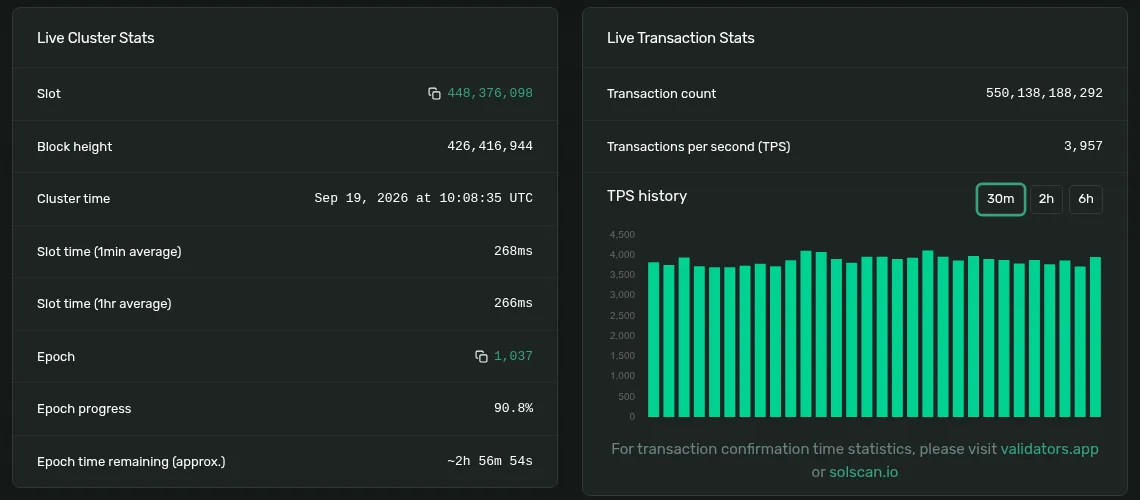
- The current slot. It advances every ~400 ms whether or not a block was produced.
- The measured slot time, averaged over the last minute.
- The epoch: 432,000 slots, roughly two days.
- How far through the epoch the network is. The leader schedule rotates at 100%.
- Transactions per second, including the validators' own vote transactions.
A transaction passes through three stages, and explorers and wallets label them:
| Processed | A leader included it in a block. Not yet safe — that block could still be skipped. |
|---|---|
| Confirmed | A supermajority of stake has voted for the block. This is what most wallets show as done, and it is very rarely reversed. |
| Finalized | At least 31 further blocks have been built on top of it. Irreversible. |
SOL and lamports
SOL is the network's native token. It pays transaction fees, it is the deposit that keeps accounts alive (rent — covered in The account model), and staking it is what secures the network. The smallest unit is the lamport: 1 SOL = 1,000,000,000 lamports. Fees and rent are quoted in lamports, balances in SOL. A basic transaction costs 5,000 lamports per signature — 0.000005 SOL.
Clusters: mainnet, devnet, testnet
There are several independent copies of the network, called clusters. Mainnet-beta is the real one, where SOL has value. Devnet is a public playground with free SOL from a faucet — same programs, same tools, nothing at stake. Testnet is where validators rehearse upgrades. Every Solstack tool runs on devnet and mainnet; start on devnet.
Programs, not smart contracts
Code on Solana lives in programs — the equivalent of smart contracts elsewhere, with one big difference: a program holds no data of its own. It is pure logic, and the state it operates on lives in separate accounts that are handed to it with each transaction. That separation is the most important idea on the chain, and The account model builds on it.
What to remember
- Solana is a Proof-of-Stake network that uses Proof of History as a shared clock: ~400 ms blocks, sub-second confirmation.
- 1 SOL = 1,000,000,000 lamports. Fees and rent are quoted in lamports.
- Processed → confirmed → finalized. Wait for confirmed at least; finalized cannot be reversed.
- Devnet is a free, real copy of the network for practising. Mainnet-beta is where value lives.
- Programs are logic only. The data lives in accounts passed to them.