Beginner· Lesson 1 of 8· 7 min
What is a blockchain?
A ledger that thousands of strangers keep identical copies of, that anyone can read, and that only changes when the rules say so. Here is the whole mechanism, from a hash to a finalized block.
Strip away the jargon and a blockchain is a record of who owns what. Banks keep one of those too. The difference is who keeps it and who can change it. A bank keeps the only copy and edits it on your behalf. A blockchain is kept by thousands of independent computers at once, changes only when the majority agree that a change followed the rules, and anyone can read every entry ever made. Everything else — blocks, mining, validators, wallets — exists to make that possible without a bank in the middle.
The problem being solved
Digital things copy for free. If money is a file, what stops you paying the same file to two people? Before 2009 the only answer was a trusted keeper: a bank, a card network, PayPal, whose one ledger decides which payment counts. Bitcoin's contribution was a way for strangers who don't trust each other, some of whom may be lying, to agree on a single history of payments anyway. Computer scientists call that Byzantine fault tolerance; the practical name is consensus.
Hashes: fingerprints for data
A hash function takes any data and produces a fixed-size fingerprint, 32 bytes for SHA-256. The same input always gives the same output; a different input, even by one bit, gives an unrecognisably different one; and there is no way to run it backwards or to find two inputs with the same fingerprint. That makes a hash a commitment: publish the hash of something and you have fixed what it is without revealing it, and anyone can later check that a document matches.
sha256("send 2 SOL to Bob")  = 5b7c 1e0a 9f44 …  (64 hex characters)
sha256("send 3 SOL to Bob")  = e91d 03aa 27c8 …  no resemblance to the first
Blocks, and the chain
Transactions are gathered into batches called blocks. Every block contains a hash of the previous block, and the block's own hash covers that link along with all of its contents. Change anything in an old block and its hash changes, so the next block's “previous hash” no longer matches, and so on to the tip. History cannot be quietly edited; it can only be rewritten from the point of the change forward, in the open, against everyone holding a copy.
Inside a block, transactions are hashed pairwise into a tree whose single root goes in the block header — a Merkle root. It lets a phone check that one transaction is in a block by verifying a handful of hashes instead of downloading every transaction.
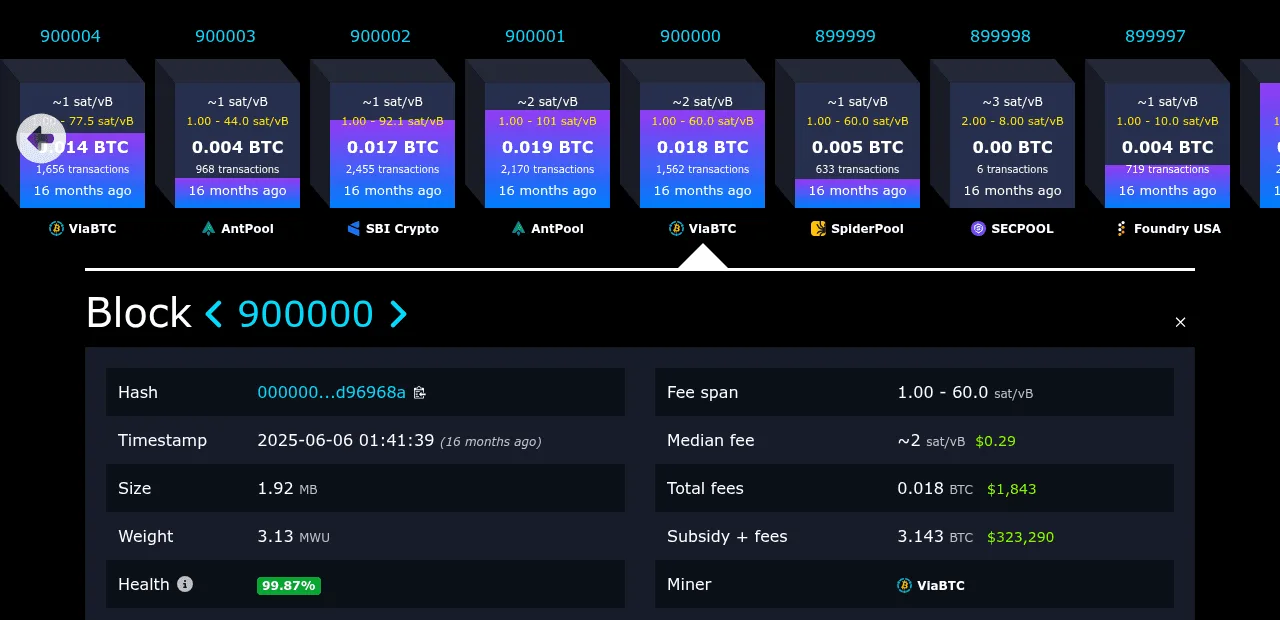
- Block 900,000, about 16 months before capture. Bitcoin adds one roughly every ten minutes.
- Its neighbours. Each links to the one before it by hash; together they are the chain.
- The block's hash starts with nineteen zeros. That is not luck: it is proof of work, explained below.
- 1,562 transactions inside, 1.92 MB. A block is a batch.
- The miner that found it. Anyone with the hardware can compete; nobody is appointed.
- The miner's reward: 3.125 new BTC plus 0.018 BTC of fees. New coins are created only here.
Signatures: who may change an entry
Balances belong to public keys. To spend, you sign the transaction with the matching private key; anyone can verify the signature with the public key alone. So the rule for changing the ledger is mathematical, not institutional: an entry moves when a valid signature says so, and there is no one to appeal to or to bribe. This is also why losing a private key loses the coins for good — no signature can ever be produced again. Wallets, keys and addresses covers keeping them safe.
Consensus: who writes the next block
Signatures settle who may spend. They do not settle order: if I sign two transactions spending the same coin, which one counts? That is the job of consensus. Somebody proposes the next block, everyone else checks it, and the network needs a way to make proposing expensive enough that lying is not worth it.
| Proof of work (Bitcoin) | Proposers race to find a block whose hash falls below a target — those leading zeros — by trying trillions of variations. Winning costs electricity; rewriting history means redoing that work faster than the whole network. Blocks every ~10 minutes. |
|---|---|
| Proof of stake (Ethereum, Solana) | Proposers are chosen in proportion to coins they have locked up as stake, and the rest vote. Lying risks the stake (on Ethereum by slashing; on Solana by lost rewards). Blocks in seconds or less. |
Either way, the security assumption is the same: the majority of the resource — hashing power or stake — is honest. Control more than half and you can censor or reorder recent transactions, though still not forge signatures or spend anyone else's coins. Acquiring that majority on a large network costs more than it could steal, which is the whole economic argument.
Confirmation and finality
Two honest proposers can briefly produce competing blocks, a fork, and the network resolves it by following the longer or heavier chain. So a transaction in the newest block is not quite settled. On Bitcoin, settlement is probabilistic: each block built on top makes a reversal exponentially harder, and six blocks (about an hour) is the convention for large amounts. Proof-of-stake chains add explicit finality: once a supermajority has voted on a block, protocol rules forbid reverting it. Solana marks a block confirmed after a supermajority vote, within about a second, and finalized after 31 more blocks are built on it.
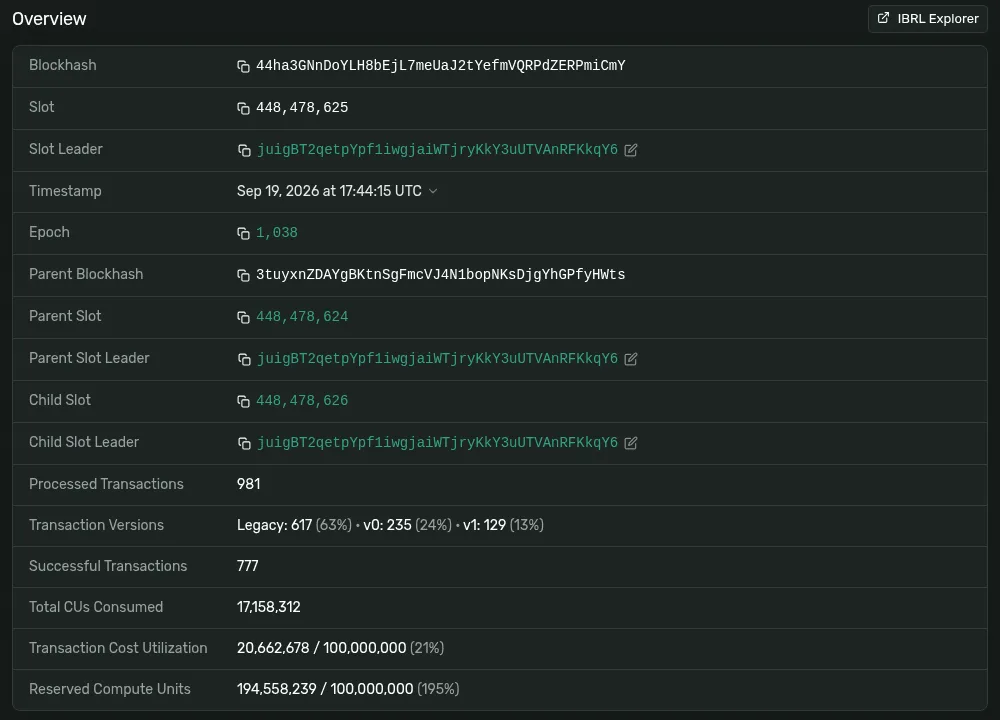
- The block's hash: its fingerprint, covering everything below.
- Its slot: Solana's block number, one every 400 ms.
- The validator that proposed it. Leaders are scheduled by stake, four slots each.
- The parent's hash: the link that makes this a chain.
- 981 transactions in 400 ms, including validators' own votes.
- 777 succeeded. A failed transaction is still recorded; the ledger keeps the attempt.
- The block used 21% of its compute budget. Capacity, not demand, sets the ceiling.
Nodes, and what “decentralised” buys
A node is any computer running the network software with a full copy of the ledger. Validators are nodes that also take part in consensus. Because thousands of nodes hold the same data and check the same rules, no single company can take the network down, freeze an account, roll back a payment or change the money supply. That is what decentralisation means in practice: not that nobody is in charge, but that changing the rules requires most of the participants to agree, in public.
| Open | Anyone can read the ledger, send a transaction or run a node. No account, no permission. |
|---|---|
| Neutral | Transactions are valid or not by rule. Who you are does not enter into it. |
| Final | A settled transaction cannot be reversed by anyone, including the sender. |
| Transparent | Every balance and every transfer, ever, is public. Pseudonymous, not private. |
Programs: rules beyond payments
Bitcoin's rules are fixed: move coins with a signature. Later chains let anyone upload code — smart contracts, or on Solana, programs — that the validators all run identically as part of consensus. The code can hold coins and release them only when its conditions are met, which turns the ledger into a machine for enforceable agreements: exchanges with no operator, loans with no lender, tokens for anything. The same guarantees apply: nobody can stop the code or change its outcome once it is deployed, for better and worse.
What a blockchain is bad at
- Throughput. Every node processes every transaction, so capacity is a fraction of a single database's. Chains trade decentralisation for speed differently; Solana leans hard toward speed.
- Privacy. Public by default. Pseudonyms are linkable, and mistakes are permanent.
- The outside world. The ledger knows nothing off-chain. Prices, weather, sports results come from oracles, which are a trust assumption.
- Mistakes. No fraud department. Send to the wrong address and it is gone.
- Cost of storage. Every node stores everything forever, so keeping data on-chain is priced accordingly.
Where Solana fits
Solana is a proof-of-stake blockchain built for throughput: a block every 400 milliseconds, thousands of transactions a second, fees under a cent, and programs as first-class citizens. It does that with a few unusual choices, which the next lessons cover: a cryptographic clock so validators agree on time without talking, transactions that declare what they touch so they can run in parallel, and a ledger where everything — balances, tokens, programs — is one kind of thing, an account.
What to remember
- A blockchain is a shared ledger kept in thousands of identical copies, readable by anyone, changed only by rule.
- Hashes chain blocks so history is tamper-evident; signatures decide who may move a balance.
- Consensus decides the order of transactions. Proof of work makes proposing costly; proof of stake makes lying costly.
- Confirmation becomes finality as more blocks or votes pile on. Then no one can reverse it.
- Decentralisation buys openness, neutrality and finality, at the price of throughput, privacy and forgiveness.