Money is a ledger entry. A cryptocurrency is a ledger entry that moves on a signature instead of an institution's say-so, with a supply set by code. What that changes, what it doesn't, and how to read a price page without being fooled.
Money was already numbers
Most money is not notes and coins; it is balances in bank databases, moved by the banks on instruction. Your salary arrives as an edit to a row. A card payment is two banks agreeing to edit two rows. The system works because the banks are trusted to keep the rows honest and are regulated so that they mostly do. A cryptocurrency keeps the same idea — balances in a ledger — and replaces the trusted editor with the blockchain from the previous lesson.
Same ledger, different rules about who can change it and who can see it.
Who can move it
Bank money: the bank, on your request or a court's order. Crypto: whoever holds the private key, and no one else.
Can it be reversed
Bank money: yes, by the bank. Crypto: no, by anyone.
Who can see it
Bank money: you, the bank, authorities. Crypto: everyone, by address.
Who can create it
Bank money: central banks and, through lending, commercial banks. Crypto: the protocol's schedule, and nothing else.
Who can hold it
Bank money: anyone the bank accepts. Crypto: anyone who can generate a keypair, which is everyone.
Coins and tokens
Every blockchain has a native coin: BTC on Bitcoin, ETH on Ethereum, SOL on Solana. It pays the fees that keep the network running, and on proof-of-stake chains it is what validators lock up to take part. Chains with programs also carry tokens: balances tracked by a program rather than by the base protocol, created by anyone, for anything — a company's stablecoin, a game's currency, a memecoin, a share in a liquidity pool. On Solana every token follows one standard, which is why one wallet shows them all. SPL tokens explains how.
Native coins
BTC, ETH, SOL. Scarce by protocol rule, needed to use the chain, secured by consensus itself.
Stablecoins
USDC, USDT, PYUSD. Tokens pegged to a currency, backed by reserves an issuer holds. Convenient; the issuer can freeze them and must be trusted to hold the reserves.
Utility and governance tokens
Give access to a service or a vote in a protocol. Worth what that access or vote is worth.
Memecoins
Tokens with no function beyond being traded. Their price is entirely attention.
NFTs
Tokens with a supply of one, used as proof of ownership of a specific thing.
Where new coins come from
No one prints a cryptocurrency. The rule for issuing it is code every node enforces, and it varies. Bitcoin pays new coins to miners per block, halves the amount every four years, and stops at 21 million. Solana pays new SOL to stakers at a rate that started at 8% a year and falls toward 1.5%, with part of every fee burned against it. A stablecoin's supply is whatever the issuer has minted against its reserves.
Two issuance rules. Bitcoin's is a hard cap approached in steps; Solana's is a declining inflation rate with no cap.
123
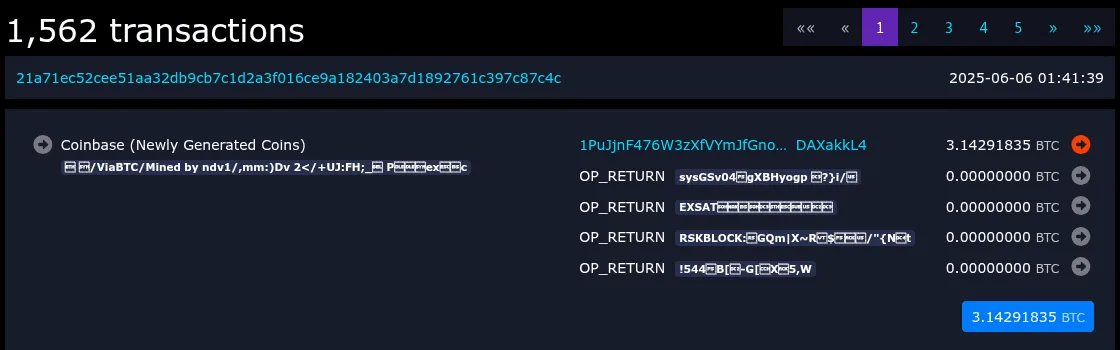
The block's transaction list. The first entry in every Bitcoin block is special.
“Newly generated coins”: no sender. This is the only way BTC comes into existence.
3.14291835 BTC: the 3.125 BTC subsidy after the 2024 halving, plus that block's fees.
New money being created, on the record, captured 19 Sep 2026 · mempool.space
123
Circulating SOL: what can be freely traded today.
Total SOL in existence, including locked and vesting allocations. The gap is future selling pressure.
How much is staked: locked up to secure the network and earn the inflation.
A cryptocurrency is worth what people will pay for it, like any currency or asset. What supports that willingness varies. A native coin has demand from use — every transaction needs it, every validator locks it — and a supply rule that cannot be changed by a committee. A stablecoin is worth its backing. A governance token is worth the cash flows or control it carries. A memecoin has none of these, only the expectation that someone else will pay more. Prices are volatile because the market is young, global, always open and thin relative to the claims made about it.