Beginner· Lesson 5 of 6· 3 min
Devnet: practising with free SOL
Devnet is a real Solana cluster where the SOL is free. Everything you will ever do on mainnet can be rehearsed here first, with nothing at stake.
Solana runs as several independent clusters. Mainnet-beta is where value lives. Devnet runs the same validator software and the same core programs on a separate ledger, and hands out SOL from a faucet. Testnet exists for validators to rehearse upgrades and is not for app testing.
What carries over and what doesn't
| Your keypair | Identical on every cluster. The same address is a wallet on all three. |
|---|---|
| Core programs | System, Token, Token-2022, Associated Token, Metadata: same addresses, same behaviour. |
| Balances and tokens | Separate. A token minted on devnet does not exist on mainnet and cannot be moved there. |
| Third-party programs | Some deploy to devnet, many don't. Exchanges and launchpads are often mainnet-only. |
| Rent and fees | Same rules and numbers, in SOL that costs nothing. |
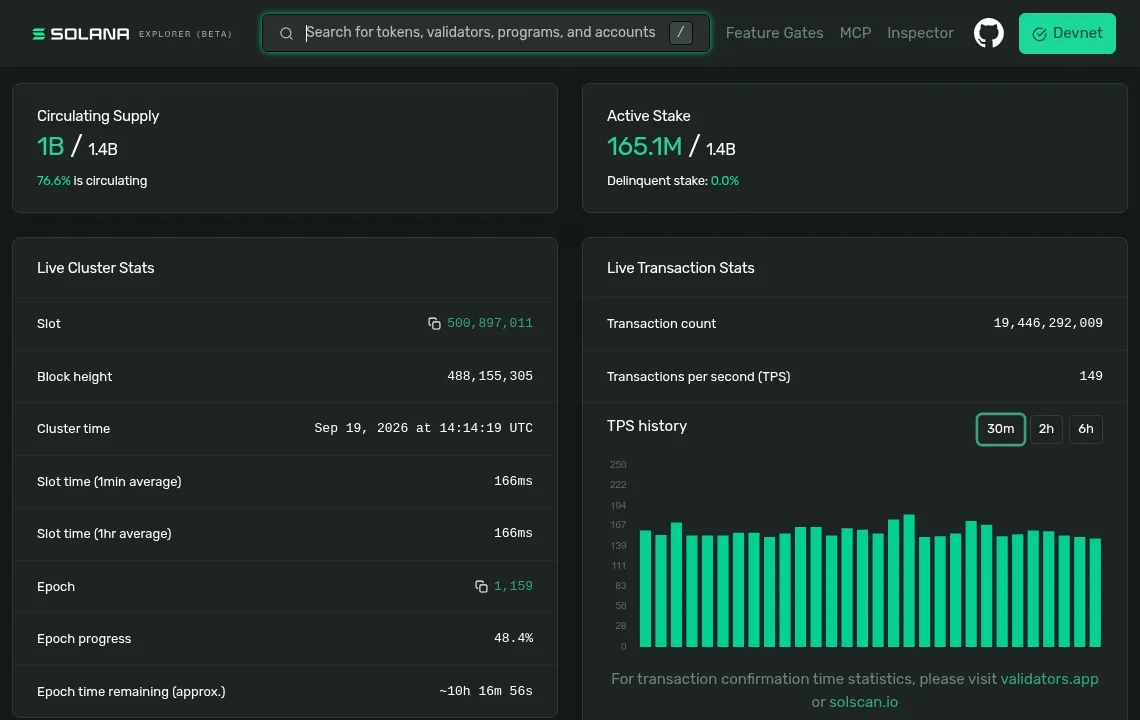
- The cluster switch. Every explorer has one; forget it and a devnet address shows as empty.
- Devnet's own slot counter. It has been running for years, on its own clock.
- Its own epoch number too. Nothing here lines up with mainnet.
- Real traffic: developers' tests and bots, a fraction of mainnet's load.
- Stake with no value behind it. Devnet validators are run by the Foundation and volunteers.
Getting devnet SOL
Faucets are rate-limited per address and per IP — typically a couple of SOL an hour — so ask for what you need rather than all you can. Solstack's Devnet Faucet sends to any address; the official one is at faucet.solana.com; the CLI does it in one line.
solana config set --url devnet
solana airdrop 1 <YOUR_ADDRESS>
solana balance <YOUR_ADDRESS>
Switching your wallet
Wallets hide the switch behind developer settings. In Phantom: Settings → Developer Settings → enable Testnet Mode, then pick Solana Devnet. In Solflare: the network selector in settings. Backpack has a per-wallet network. The address does not change; the balance you see does, because the wallet is now reading a different ledger.
A practice run
- Switch the wallet to devnet and request 1 SOL from the faucet.
- Open SPL Token Creator on devnet and mint a token: name, symbol, supply, logo.
- Find it on an explorer with the cluster set to devnet. Read the mint's supply, decimals and authorities.
- Create a second wallet (a burner) and send it some of the token. Notice the token account created for it, and its deposit.
- Revoke the mint authority in Token Manager. Confirm the field now reads none.
- Close the burner's empty token account with Rent Reclaim and watch the deposit return.
Every step is the same transaction you would sign on mainnet, built by the same code. The only difference is the RPC endpoint.
Gotchas
- Explorer links need
?cluster=devnet. Without it the page shows a mainnet account that does not exist. - Devnet is occasionally reset by the Foundation. Don't keep anything you can't recreate.
- The public devnet RPC is shared and throttled. Retry, or use a free tier from an RPC provider.
- A “your token is live” message that links to a devnet explorer page is a common scam. Value only exists on mainnet.
- Some programs behave slightly differently on devnet because they were deployed there at a different version. Read the program's own docs.
What to remember
- Devnet is the same software and core programs as mainnet, on a separate ledger, with free SOL.
- One keypair works everywhere. The wallet's network switch and the explorer's cluster switch choose the ledger.
- Tokens and balances never cross clusters. A devnet token has no mainnet existence.
- Faucets are rate-limited: ask for what you need.
- Rehearse every mainnet action on devnet first. The transactions are identical.