Intermediate· Lesson 4 of 8· 3 min
Authorities: mint, freeze and update
A handful of keys decide what can still happen to a token after launch. Knowing who holds each one is most of the trust check, and revoking them is one transaction.
An authority is a field in an account that names a public key, or nothing. When an instruction needs that permission, the owning program checks that the named key signed the transaction. There is no role system behind it: the field is the permission.
The authorities on a token
| Mint authority | On the mint. Can create new supply into any token account. None means the supply is fixed forever. |
|---|---|
| Freeze authority | On the mint. Can freeze or thaw any token account for this mint; a frozen balance cannot move. None means no one ever can. |
| Update authority | On the metadata. Can change name, symbol and URI while the record is mutable. |
| Token account owner | On each token account. The wallet that can spend that balance; what your signature proves. |
| Delegate | Optional, on a token account. A second key allowed to spend up to an approved amount. |
Token-2022 adds a few more per extension: a transfer-fee authority that can change the fee, a withdraw-withheld authority that collects it, a permanent delegate that can move any holder's tokens, a close-mint authority, and an update authority on the mint's own metadata. Token-2022 extensions covers them.
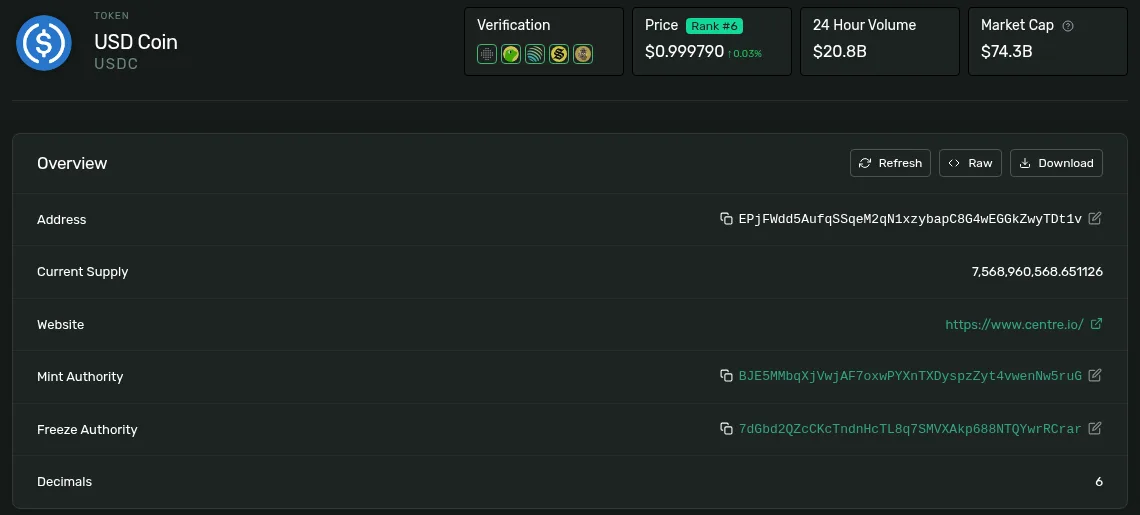
- Mint authority: a key. Circle can issue more USDC, which is the whole point of a stablecoin.
- Freeze authority: a key. Circle can freeze an account under a court order. Reasonable here, alarming on a memecoin.
Revoking
The Token program's SetAuthority instruction changes an authority to a new key or to none. Setting none is irreversible: no key exists that could set it back, and the program has no override. Each authority is its own instruction, so revoking mint and freeze is two instructions, usually in one transaction.
- Mint the full supply first. After revoking there is no way to add more, including for liquidity or airdrops you forgot.
- Decide whether you need freeze. Almost no fair-launch token does.
- Open Token Manager with the wallet that holds the authorities and revoke both. The simulation shows two SetAuthority instructions and no transfers.
- Check the mint on an explorer: both fields read none.
- Optionally make the metadata immutable, so the name and logo are also final.
When to keep them
Stablecoins, tokenised securities, game currencies and anything with a compliance obligation keep both. Points systems keep the mint authority so they can issue. A team that plans a second distribution keeps the mint authority until it is done and says so. The rule is not “always revoke”; it is “revoke, or explain who holds it and why”.
Multisigs and programs as authorities
An authority does not have to be a person's wallet. USDC's mint authority is a multisig; many protocols set a program derived address so only their program's logic can mint. Read the authority's own account: if its owner is a multisig program such as Squads, several signers are needed; if it is a PDA owned by a program, that program's rules apply; if it is a plain System-owned wallet, one private key is all it takes. Account Inspector shows the owner in one click.
Reading them fast
In a decoded mint the two fields appear as an option: a flag and a key. Revoked looks like this:
mintAuthorityOption:   0        // none — supply is fixed
mintAuthority:         11111111111111111111111111111111
supply:                1000000000000000
decimals:              6
isInitialized:         true
freezeAuthorityOption: 0        // none — no account can be frozen
freezeAuthority:       11111111111111111111111111111111
Token Inspector reads mint, freeze and update authority together and labels each one live or revoked, alongside the holder and liquidity checks that matter just as much. Revoked authorities make a token honest about its supply; they say nothing about who holds it or whether the liquidity can be pulled.
What to remember
- An authority is a field naming a key. The owning program checks that key signed.
- Mint authority controls supply, freeze authority controls holders, update authority controls the name and logo.
- Revoking is SetAuthority to none. It cannot be undone, so mint everything first.
- Live authorities are fine when the holder is known and the reason is stated. Read who holds them: wallet, multisig or program.
- Revoked authorities are one check among several. Holders and liquidity are the others.