Intermediate· Lesson 7 of 8· 3 min
Staking and liquid staking
Staking is how SOL earns a yield and secures the network at the same time. It is also the one place the account model gets its own account type, with two authorities and an epoch clock.
Validators need stake to vote and to be scheduled as leader. They get it by delegation: you point SOL at a validator's vote account, the network counts it toward that validator's weight, and the validator shares the rewards. Rewards come from inflation — about 3.6% of supply a year in 2026, declining toward a 1.5% floor — paid to staked SOL every epoch, plus a share of block revenue where the validator passes it on. The yield works out to a few percent above the inflation rate because not all SOL is staked.
Stake accounts
A stake account is a 200-byte account owned by the Stake program. It holds the SOL, a delegation (which vote account, since which epoch) and two authorities: the stake authority, which can delegate, deactivate and split, and the withdraw authority, which can withdraw the SOL and change both authorities. Your wallet usually holds both. A validator holds neither, which is why staking is not lending: the validator cannot touch your SOL.
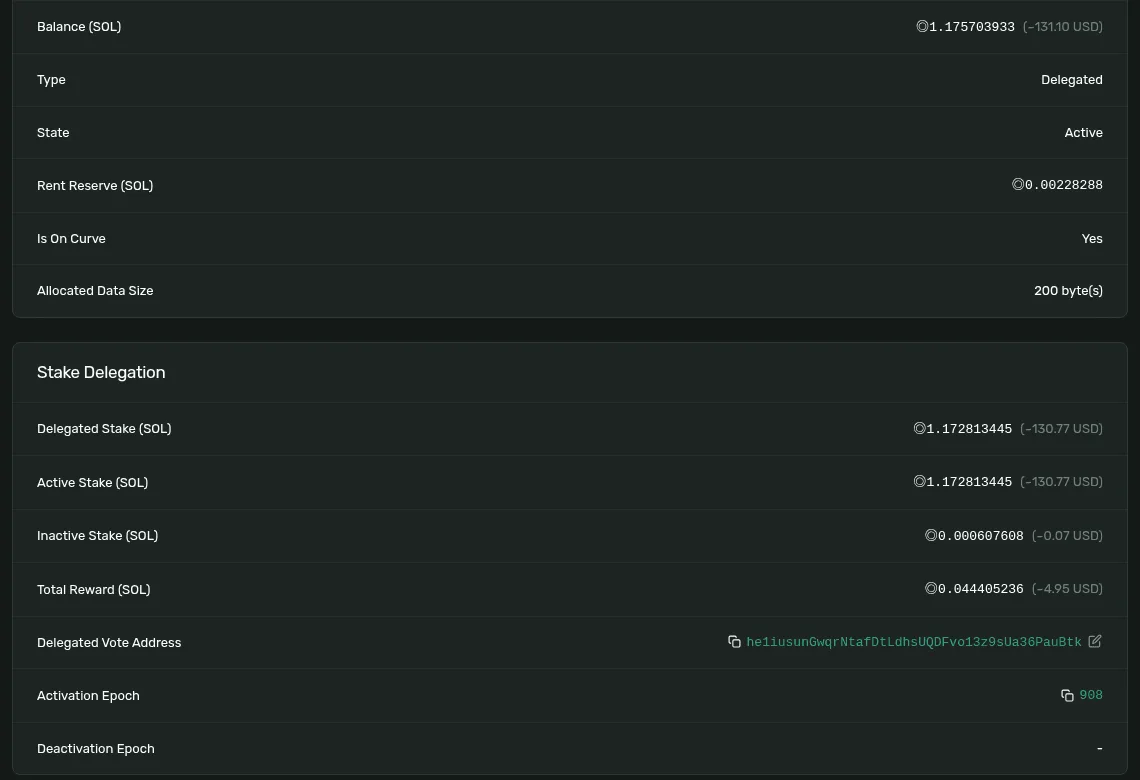
- The account's balance: the stake plus its rent reserve.
- Type: delegated. An undelegated stake account is just SOL in a box.
- State: active. It went through activating at an epoch boundary and is now earning.
- The rent reserve: the part of the balance that is the account's deposit, not stake.
- Delegated stake, all of it active.
- Rewards so far, auto-compounded into the stake. Nothing to claim.
- The vote account it is delegated to: Helius.
- Delegated in epoch 908. It began earning in epoch 909.
Epochs and warm-up
Stake changes state only at epoch boundaries, about every two days. Delegate today and the stake is “activating” until the boundary, then active. Deactivate and it is “deactivating” until the boundary, then withdrawable. Rewards are paid at the boundary too, and added to the stake, so they compound. The network caps how much total stake can change state per epoch, so in a rush the wait can stretch over more than one.
Vote accounts and commission
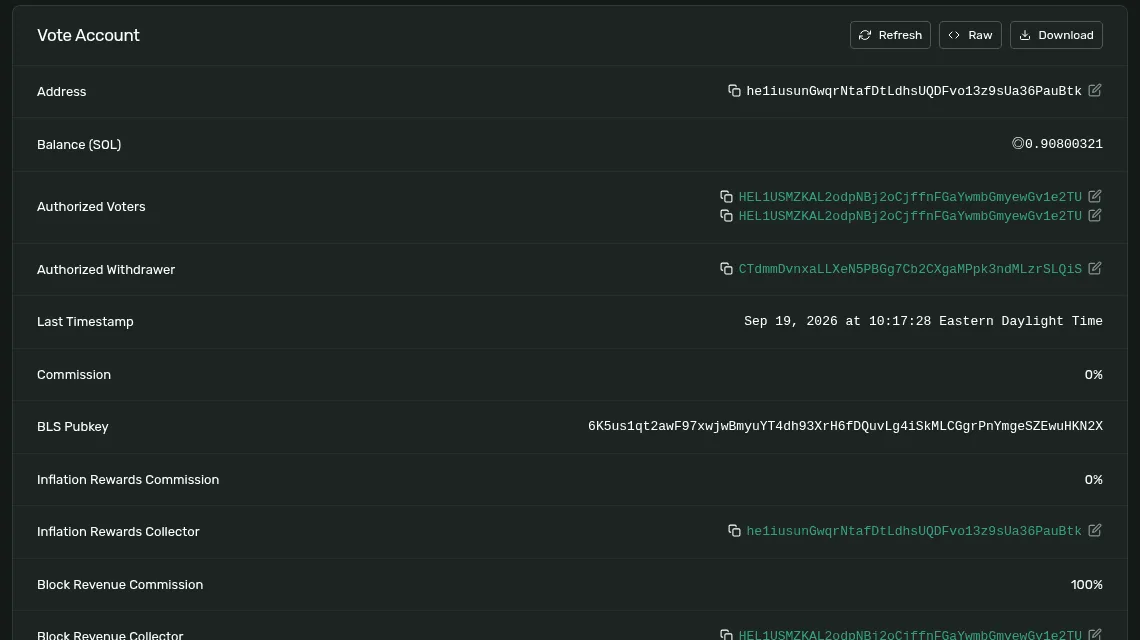
- The vote account: what you delegate to. Not the validator's node identity.
- The key the validator's node signs votes with.
- The key that can withdraw the vote account's rewards. Often a cold wallet.
- Commission on inflation rewards: 0%. The validator keeps none of your staking yield.
- Commission on block revenue: 100%. Priority fees and tips from its blocks stay with the validator.
There are two commissions now. The classic one takes a cut of inflation rewards. Since validators can share block revenue with their stakers in-protocol, a second commission says how much of that they keep. A validator advertising 0% may be keeping 100% of the other one, which for a busy validator is the larger stream. Read both.
Choosing a validator
- Both commissions, and whether the validator also pays out MEV tips.
- Skip rate and uptime: a validator that misses its leader slots earns less for everyone.
- Size: delegating to the largest validators concentrates the network. Many stakers pick from outside the top group on purpose.
- Whether it runs current software. Explorer and validator dashboards show the version.
Liquid staking
A stake pool takes your SOL, spreads it across many validators and gives you a token — JitoSOL, mSOL, bSOL, jupSOL and others — that represents your share. The token's value in SOL rises as rewards accrue, and it stays liquid: you can trade it, lend it or use it as collateral while it earns. In return you trust the pool program, its validator set and the market for the token.
| Native staking | Your stake account, your authorities, one validator, no counterparty. Unstaking takes an epoch. |
|---|---|
| Liquid staking | A token that grows in SOL terms. Instant exit by swapping (at market price) or a delayed unstake through the pool at full value. Program and peg risk. |
What staking does not do
Your keys stay yours and the validator cannot spend, move or lock your SOL. Solana has no automated slashing: a validator that misbehaves costs you missed rewards, not principal. The real risks are choosing a validator that goes offline, and — for liquid staking — the pool's code and the token's liquidity. How Solana staking works goes deeper on rewards; How to unstake SOL on getting out.
What to remember
- Delegation is a pointer in your own stake account. The validator gets weight, never custody.
- Two authorities: stake (delegate, deactivate) and withdraw (take the SOL out, change authorities).
- State changes at epoch boundaries, about every two days. Rewards compound into the stake.
- Two commissions: on inflation rewards and on block revenue. Read both.
- Liquid staking trades counterparty risk for liquidity. Native staking has neither.